
If you’re shopping for an AV partner, here’s the short version: choose an AV integrator based on how they handle your specific spaces, not on the lowest bid. The right integrator asks about how your teams actually work before they quote anything, gives you a clear scope in writing, and is around after install day. The wrong one sells you boxes and disappears.
That’s the whole answer. The rest of this post is how to tell which one you’re talking to.
Why this decision is harder than it looks
Most people buying commercial AV aren’t AV experts, and they shouldn’t have to be. You know you need conference rooms that connect on the first try, a training space people can actually hear in, or an LED video wall that doesn’t freeze during the all-hands. What you don’t know is which of the five companies on your list will deliver that and which will leave you with a closet full of gear and a support number nobody answers.
The gap is real because AV sits in an awkward spot. It’s part construction, part IT, part design. A company can be great at pulling cable and terrible at programming a control system. They can win on price and lose you a week of productivity every time a room glitches. Hiring an AV company well means looking past the proposal and at how they think.
Start with how they scope the project
The first real signal shows up before you ever see a number. Watch how the integrator gathers information.
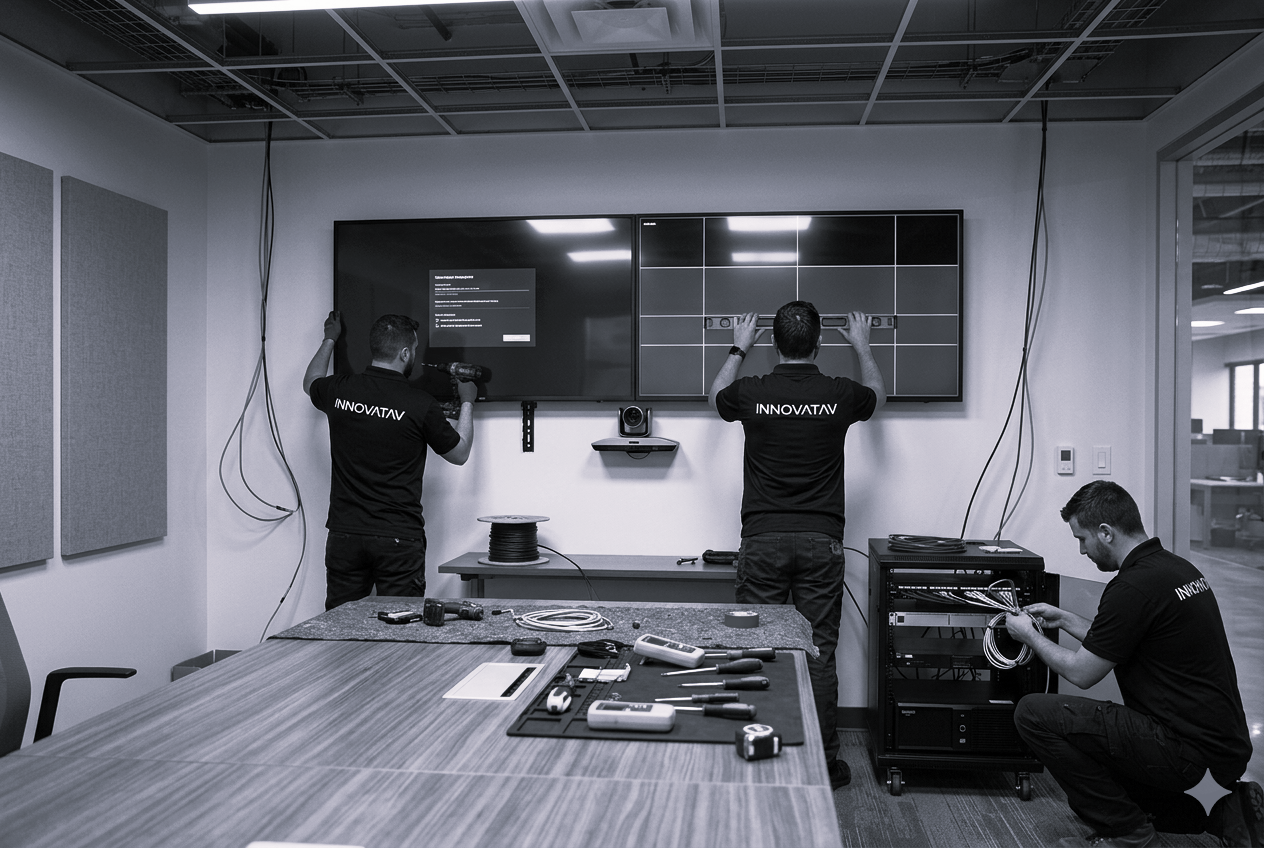
A good one wants to see the rooms. They ask who uses each space and for what. They ask whether you’re on Teams or Zoom or both, whether IT wants devices on a separate network, and what’s already on the walls. They ask about the stuff that bites you later, like ceiling height, HVAC noise, and where the power actually is.
A weak one emails you a quote off a floor plan and a phone call. That quote will look cheaper. It’s cheaper because it’s missing things, and you’ll pay for those things later as change orders.
So the first question to ask an AV integrator is simple: “How do you figure out what we actually need?” If the answer involves a site walk and conversations with the people who’ll use the rooms, you’re in good hands. If it’s “send us the dimensions,” keep looking.
The questions to ask an AV integrator before you sign
Here’s a list you can take straight into a meeting. The answers tell you more than any brochure will.
- Who does the actual install, your people or subcontractors? Subs aren’t automatically bad, but you want to know who’s accountable and whether the crew has worked together before.
- Who programs the control systems and where are they based? Remote programmers in another time zone can mean slow fixes. Ask.
- What does your support look like after install? Get specifics. Response times, whether there’s a service agreement, whether they monitor systems remotely or wait for you to call.
- Can I talk to a client with a setup like mine? A real commercial AV contractor will have references for spaces close to yours and will hand them over without stalling.
- What happens when something breaks in year two? This separates partners from sellers. You want to hear about service plans and parts availability, not silence.
- Will I get full documentation and as-built drawings? You need to own your system. If they keep the passwords and the diagrams, you’re trapped.
- How do you handle changes mid-project? Changes happen. The question is whether they’re handled openly or sprung on you at invoicing.
If an integrator gets cagey on any of these, that’s your answer.
What separates a partner from a box-pusher
There’s a type of AV company that sells hardware and calls it a day. The proposal is a parts list with a markup. They’ll tell you what you asked for is “no problem,” install it, and move on.
A real partner does something different. They push back when your idea won’t work. They tell you the cheaper display is fine for the huddle room but wrong for the boardroom and explain why. They think about the person standing in the room three years from now trying to start a call, not just the gear going in this month.
You can hear the difference in how they talk. Box-pushers talk about products. Partners talk about outcomes, like “people join calls without help” or “the room resets itself between meetings.” That shift in language is one of the most reliable tells there is.
Red flags worth walking away from
A few patterns show up again and again on projects that go sideways:
- A quote that’s dramatically lower than everyone else’s. It’s not a deal. Something’s missing, and you’ll find out what during install.
- No site visit before a “final” number. You can’t accurately quote AV from a floor plan.
- Vague scope. If the proposal says “audio system” instead of listing what’s actually going in, you have no idea what you’re buying.
- Pressure to sign fast. Good integrators are busy and confident. They don’t need to rush you.
- No references for your type of space. Doing great work in a restaurant doesn’t mean they can build a courtroom.
None of these alone is fatal, but two or three together is a clear sign to slow down.
Local matters more than you’d think
There’s a reason searching for local AV installation beats hiring whoever has the slickest national website. When a screen goes dark before a board meeting, you want someone who can be on site, not someone routing a ticket through a call center.
A local integrator knows the buildings, often knows your IT vendors already, and can swing by for a fifteen-minute fix instead of scheduling a flight. That proximity is worth real money over the life of a system. When you’re comparing a commercial AV contractor down the road against a name from three states away, factor in what support actually looks like at 8 a.m. on a Monday. The same logic applies when the need is short-term rather than permanent: AV rental across Toronto and the GTA puts the same local-response question in front of you on a much smaller commitment.
A simple way to compare your options
Once you’ve talked to two or three integrators, line them up against the same questions:
- Did they understand our spaces? Not the gear, the way people use the rooms.
- Is the scope clear and complete? Could a stranger read the proposal and know exactly what’s being installed?
- Is support real or theoretical? Specific commitments beat friendly promises.
- Do the references check out? Call them. Ask what they’d change if they did it again.
- Do we trust them? You’re going to work with these people through a messy process. Gut feeling counts.
The integrator who wins on those five questions is almost never the cheapest, and almost always the one you’re glad you picked.
Ready to talk through your project?
If you’re weighing AV companies right now, the best thing you can do is have a real conversation with one and see how they think. At InnovatAV, we start every project by understanding your spaces and how your teams work, then build a plan around that, not around a parts list. You can see the range that covers on our AV services for corporate events page.
Reach out for a quote or a quick call about your project. We’ll walk your space, ask the questions that matter, and give you a clear scope you can actually compare against anyone else’s. No pressure, no jargon, just a straight answer on what your spaces need.